

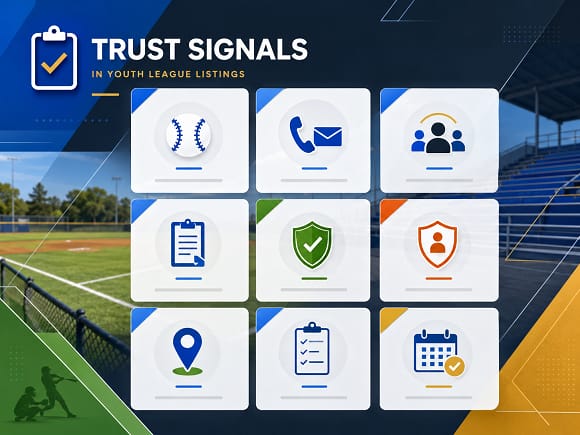
Youth league listings should include governance, contact, and verification signals because families are not only choosing a team. They are trusting an organization with registration fees, volunteer leadership, schedules, facilities, equipment, safety rules, and communication around children’s sports. A listing that shows only a league name and sign-up link leaves parents with too many unanswered questions. For EfficientDirectory.com, which focuses on local sports leagues, teams, schedules, sign-ups, fields, coaches, review signals, and listing accuracy, youth sports discovery should make basic trust signals visible before a family registers.
Why The Las Vegas Little League Case Makes Verification More Important
The recent Central Little League of Las Vegas case shows why youth sports listings need stronger verification signals. People reported that Steve Rodriguez Prado, 38, the former president of Central Little League of Las Vegas, was arrested on July 2, 2026, on suspicion of theft and forgery. Authorities alleged that Prado embezzled $64,351.24 from the local youth baseball organization between December 2025 and April 2026, after a board member raised concerns that led to an investigation by the Las Vegas Metropolitan Police Department. The Las Vegas Little League allegations should be handled carefully: the case is allegation-based, not a final legal outcome.

Local reporting from KSNV also said Prado was accused of stealing more than $64,000 in league funds, with court records showing a future court appearance. The Central Little League of Las Vegas report matters for families because youth leagues often operate through volunteer boards, seasonal sign-ups, sponsorships, donated funds, registration payments, and parent trust.
A directory should not imply that one case represents every youth league. Most youth sports organizations depend on dedicated volunteers, coaches, parents, and community supporters. The lesson is narrower and more practical: families need easier ways to identify official contacts, leadership structure, registration source, background-check policies, refund rules, and the organization’s current status before paying fees or sharing personal information.
For EfficientDirectory.com, this is a listing-quality issue. A good youth league listing should help parents distinguish between an official league, a team page, a registration vendor, a coach-managed group, a nonprofit, a school-affiliated program, or an unaffiliated social media page.
What Governance Signals Should Appear In A Youth League Listing
Governance signals help parents understand who is responsible for the organization. A youth league may have a president, board, treasurer, registrar, coach coordinator, safety officer, field scheduler, or district representative. If those roles are not visible, parents may struggle to know who handles money, scheduling, complaints, refunds, equipment, background checks, or emergency communication.
A useful youth league listing should include the official organization name, sport, location, current season, governing body or affiliation, registration source, public contact, and last verified date. For baseball and softball, for example, a local program may be affiliated with Little League International, Babe Ruth League, PONY Baseball and Softball, Cal Ripken Baseball, a city recreation department, or an independent travel organization. Those affiliations are not interchangeable.
Little League International’s official background-check page says all U.S. leagues and districts must conduct an annual background check that includes a nationwide criminal search, National Sex Offender Registry search, U.S. Center for SafeSport Centralized Disciplinary Database review, and Little League International Ineligible List review. A directory can link families to the official Little League background check requirements when a listed league claims Little League affiliation.
That does not mean a directory can certify a league’s compliance. It means the listing can show families where to verify the standard. Clear governance labels help parents ask better questions before registration.
What Contact Details Families Need Before Registration
A youth league listing should make official contact paths clear. Families need to know who to contact for registration, eligibility, payment questions, refund rules, uniforms, field changes, schedule updates, safety concerns, and volunteer requirements. A vague contact form is less useful than a structured listing that separates roles.
| Listing Signal | What Families Need To See | Why It Matters |
|---|---|---|
| Official League Name | Full legal or official operating name where available | Prevents confusion with similarly named teams |
| Primary Contact | Registrar, league email, recreation office, or official support contact | Gives parents a reliable first step |
| Leadership Structure | Board, director, city program, school department, or private operator | Shows who governs the program |
| Registration Source | Official league site, city page, school page, or approved vendor | Reduces payment and impersonation risk |
| Safety And Screening Note | Background-check policy, SafeSport note, or official youth-safety source | Helps families verify adult oversight |
| Last Verified Date | When the listing information was checked | Reduces outdated contact problems |
This format does not rank the league or invent trust. It gives families practical signals. A listing may say “board contacts posted,” “official registration source verified,” “background-check policy linked,” or “public contact not posted.” Those notes are more useful than unsupported praise.
Contact clarity is also important when a league changes leadership. Youth sports boards can change each season. A listing that was accurate last year may point families to the wrong person today. A “last verified” field helps parents know whether they are looking at current information.
Why Verification Signals Matter For Payments And Donations
Youth sports payments can include registration fees, uniforms, tournaments, fundraising, sponsorships, concessions, equipment fees, field rentals, and travel costs. Families may pay through a league site, a city recreation system, a school portal, a national registration vendor, or a payment app. When the payment path is unclear, trust risk rises.
The Las Vegas allegations involved unauthorized league-fund activity, according to recent reporting. A directory should not turn that into a broad claim about youth sports finances. It can still use the case to explain why payment verification belongs in listings. Parents should know whether they are paying the official league, an approved registration system, a city department, or an individual.
Youth league listings should avoid publishing sensitive bank details, but they can show official payment signals. A listing can identify the official registration page, warn families not to pay through unofficial links, note whether the league uses a recognized platform, and encourage verification through the league’s public contact.
For nonprofit youth sports organizations, basic governance and recordkeeping are also part of public trust. The IRS explains that tax-exempt organizations must meet ongoing responsibilities, including recordkeeping, annual filing, and compliance with exemption requirements. A directory should not give tax advice, but it can point families and league administrators toward IRS tax-exempt organization responsibilities when nonprofit status is relevant.
The key listing standard is simple: if money changes hands, the official payment source should be clear.
How Background Check And Safety Notes Should Be Handled
Background-check language should be careful. A listing should not promise that every adult has been screened unless the directory has verified that directly through the organization or official system. It can show the policy source, the governing body’s requirement, and the verification status.
The National Council of Youth Sports says identifying the right staff and volunteers to work with youth athletes is one of the most important business decisions youth organizations make. Its official youth sports background check guidelines describe recommended screening practices for youth-serving organizations. That kind of source gives directories a responsible framework without turning the listing into a legal judgment.
For a youth league listing, a safety note might say “background-check policy posted by governing body,” “volunteer screening source available,” “coach list not posted,” or “contact league to verify current screening process.” That is more accurate than a vague “safe league” label.
Families should also understand the limits of a background-check note. Screening is one signal, not the whole trust picture. Communication, supervision, complaint handling, financial controls, field safety, emergency plans, and transparent leadership all matter. A directory can help by separating those signals rather than using one all-purpose rating.
For EfficientDirectory.com, the goal is not to investigate every league. The goal is to show what is known, what is official, and what families should verify.
Why Review Signals Should Be Criteria-Based, Not Hype-Based
Youth league reviews can help families, but only if they are organized around clear criteria. A generic five-star score may not tell parents whether the league communicates well, keeps fees transparent, posts schedules on time, maintains fields, screens volunteers, handles refunds clearly, or responds to parent concerns.
A stronger listing can organize review signals around practical categories: governance clarity, official contact, registration accuracy, coach communication, schedule reliability, fee transparency, field access, safety communication, and parent support. Those categories help families interpret reviews more accurately.
The Federal Trade Commission’s Consumer Reviews and Testimonials Rule addresses deceptive practices involving reviews and testimonials. A local sports directory should follow that principle by avoiding fake reviews, invented ratings, undisclosed paid praise, or unsupported “best league” claims. The FTC’s consumer review rules support a transparent approach to review presentation.
This matters because youth leagues are community organizations, not ordinary retail products. A parent’s review may reflect one coach, one season, one age group, one field, or one board. A directory should avoid turning limited comments into broad claims about the entire organization.
Criteria-based review notes are more useful. “Registration source verified, public board contacts posted, field schedule updated, refund policy not posted” gives families a clearer picture than “popular local league.”
How Official Affiliation Should Be Verified
Official affiliation is one of the most important listing signals. A league may use a familiar sport name, neighborhood name, mascot, or social media page, but families need to know whether it is officially affiliated with a larger governing body or operating independently.
For Little League programs, families can use Little League’s official league finder and organization resources to verify local affiliation. A directory can link to the relevant official source when a league claims membership or chartered status. For other sports, the equivalent may be a national governing body, city recreation department, school athletics page, regional association, or sanctioning organization.
A listing should not guess affiliation based on uniforms, logos, or parent comments. It should state the source. If the official status is unclear, the listing can say “affiliation should be verified before registration.” That protects families and the directory.
Official affiliation also affects rules. A city recreation baseball league, a Little League chartered program, a travel baseball club, and a private academy may all serve youth players, but they may follow different age rules, safety policies, insurance structures, tournament paths, and volunteer requirements.
For EfficientDirectory.com, this is exactly where local sports discovery becomes useful. A listing can help families compare organizations by structure, not just by distance.
What Families Should Verify Before Joining A Youth League
Families should verify the official league name, governing body, registration page, leadership contact, payment method, refund policy, coach or volunteer screening policy, season dates, field locations, equipment requirements, and communication channel before registering.
They should also ask who controls the money. Is payment made to the official league, the city, a school, a national platform, or an individual? Is there a treasurer or board contact? Are sponsorships and donations handled through an official channel? Is the registration link listed on the league’s official page?
Parents should verify how disputes or concerns are handled. A strong league should have a clear route for questions about eligibility, refunds, safety concerns, coach conduct, schedule changes, and field access. A listing that shows only a social media page may not be enough for families making a payment.
Families should also check whether the listing is current. Youth sports organizations can change board members, coaches, field assignments, and registration platforms from season to season. A listing with a recent verification date is more useful than one that simply repeats old contact information.
Why Governance Signals Should Become A Listing Standard
Youth league listings should include governance, contact, and verification signals because families need trust before they register. The Central Little League of Las Vegas allegations show what can happen when leadership, money, and oversight become a public concern. The broader lesson is not that families should distrust every league. It is that directories should make official information easier to verify.
A stronger listing shows the official league name, governing body, public contact, board or director structure, registration source, payment channel, safety-screening reference, field location, review criteria, and last verified date. It separates confirmed facts from details that require parent follow-up. It avoids fake ratings, fake testimonials, unsupported “best league” claims, and unverified accusations.
That standard helps families, leagues, coaches, and volunteers. Parents get clearer information. Legitimate leagues can show their official channels. Coaches avoid answering questions that should go to registrars or boards. Directory readers can compare programs by real trust signals rather than guesswork.
For EfficientDirectory.com, governance transparency is part of accurate sports discovery. A youth league listing should help families answer three practical questions: who runs this program, how do I verify it, and where does my registration actually go? When those signals are visible, families can choose local sports opportunities with fewer surprises and stronger confidence.