
The scale of the FIFA World Cup 2026 has introduced unprecedented structural and financial strains to public venue management across the United States. Spanning 78 matches across 11 designated U.S. host cities, the tournament demands a fundamental overhaul of traditional security infrastructure. To insulate municipalities and venue authorities from catastrophic cost overheads, the Federal Emergency Management Agency (FEMA) has finalized a massive capital deployment totaling $875 million in dedicated special-event security and counter-drone subsidies. Authorized under the federal One Big Beautiful Bill Act, this funding marks a permanent shift from localized, reactive event security toward centralized, high-tech threat-mitigation frameworks at major American stadiums.
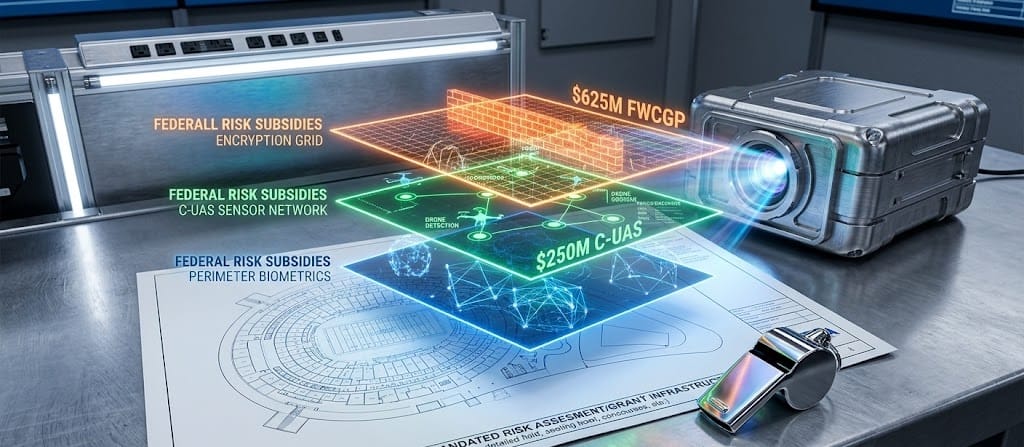
The financial injection is split into two primary operational pipelines designed to fortify the human and technological perimeters of mass gathering sites. The first is the newly established $625 million FIFA World Cup Grant Program (FWCGP), which provides direct financial relief to state and local authorities managing the immense operational surge required for games, transit hubs, and fan zones. The second is a rapid $250 million disbursement under the Counter-Unmanned Aircraft Systems (C-UAS) Grant Program, aimed at securing the airspace directly above and surrounding high-capacity sports infrastructure. For community sports administrators, stadium executives, and public safety boards, these multi-million dollar federal allocations represent a mandatory blueprint for modern risk management.
The SEAR I Mandate And Spatial Risk Management
The operational complexity of the 2026 tournament is dictated by the Department of Homeland Security’s (DHS) designation of all U.S.-based matches as Special Event Assessment Rating (SEAR) I or II events. A SEAR I classification represents the highest level of federal threat assessment, placing venues like MetLife Stadium in New Jersey, SoFi Stadium in Los Angeles, and AT&T Stadium in Texas on equal footing with National Special Security Events (NSSE) like the Super Bowl or presidential inaugurations. Achieving compliance under a SEAR I mandate requires venue operators to implement rigorous spatial risk protocols, including full-perimeter biometric access control, intensive staff background checks, and automated crowd-throughput modeling.
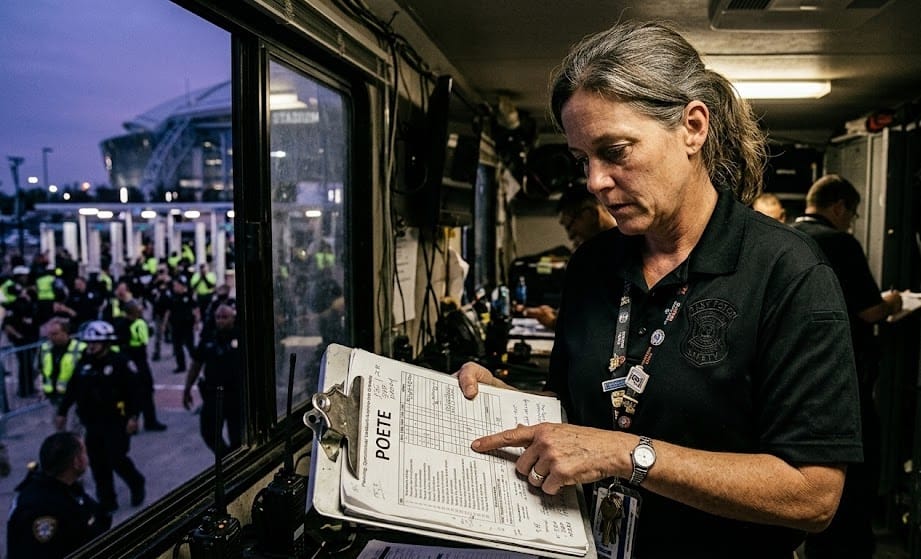
To administer these requirements effectively, the federal government channels funding through governor-designated State Administrative Agencies (SAAs) in nine host states. These agencies work directly with individual Host City Committee Task Forces to distribute capital down to local police departments, emergency medical services, and private stadium security firms. Rather than focusing capital on aesthetic or hospitality-driven venue modifications, the grant guidelines follow a strict POETE model—prioritizing Planning, Organization, Equipment, Training, and Exercises. This ensuring that the influx of cash builds long-term institutional readiness.
| Security Program Component | Total Federal Allocation | Primary Operational Destination | Compliance Imperative |
| FIFA World Cup Grant Program (FWCGP) | $625 Million | Host City Committee Task Forces via SAAs | Personnel background checks, cybersecurity, mass transit nodes |
| Counter-UAS Grant Program (C-UAS) | $250 Million | Local Law Enforcement & Stadium Security | Unlawful drone detection, electronic tracking, and tactical mitigation |
| Interagency Training & Readiness | Integrated Program Units | 238,000+ First Responders & Safety Personnel | HSEEP-compliant full-scale operational tactical exercises |
According to FEMA briefing documentation released by Senior Official Karen S. Evans, approximately 94% of the $625 million FWCGP fund is explicitly earmarked to cover operational overtime. This massive allocation supports the immense staffing surges required to maintain absolute perimeter integrity over the 38-day tournament window. For local recreation management boards and municipal facility planners, observing this level of resource deployment underscores how high-stakes global events completely alter the baseline standards for scheduling and field allocation within regional facility ecosystems, as safety considerations must supersede all standard revenue-yielding or amateur sport operations.
Counter-UAS Integration And Airspace Governance At Major Stadiums
The rapid rollout of the $250 million C-UAS Grant Program addresses an increasingly visible vulnerability in contemporary mass gathering operations: the unlawful or hostile deployment of commercial drone technology. In recent years, public assembly venues have faced growing disruptions from unauthorized unmanned aircraft systems bypassing traditional perimeter fences to breach stadium airspace. The 2026 C-UAS funding equips local law enforcement agencies with advanced technological toolsets to actively detect, identify, track, and newly mitigate drone threats in real-time.

This airspace defense architecture relies on complex sensor networks permanently or temporarily mounted to stadium superstructures. These arrays combine radio-frequency scanners, optical tracking cameras, and radar systems to pinpoint drone signatures long before they reach stadium property lines. Under the new authorities granted by the SAFER SKIES Act, trained tactical teams can deploy radio-frequency jamming equipment or kinetic intercept mechanisms to safely ground non-compliant aircraft. For sports infrastructure managers, integrating these military-grade airspace defenses requires a sophisticated understanding of localized radio-frequency environments to prevent drone-jamming signals from accidentally disrupting vital facility operations, stadium Wi-Fi networks, or digital ticketing infrastructure.
Personnel Densities and the Digital Infrastructure Pressure Loop
The execution of a whole-of-government safety strategy—coordinated closely by Andrew Giuliani, Executive Director of the White House Task Force on the FIFA World Cup 2026—ultimately hinges on the human capital deployed across host zones. More than 238,000 public safety personnel have completed specialized special-event safety and security training courses leading up to the June 11 opening whistle. This unprecedented mobilization creates a massive logistical challenge, requiring automated coordination platforms to manage shift changes, emergency medical deployments, and real-time threat reporting across multiple overlapping municipal jurisdictions.
This heavy reliance on automated communication and digital surveillance loops exposes a secondary critical domain: cybersecurity defense. Stadiums are no longer merely concrete bowls; they are highly integrated digital hubs processing millions of biometric data points, cashless financial transactions, and wireless network connections simultaneously. Recognizing this vulnerability, a substantial portion of the FWCGP funding is allocated directly to fortifying venue networks against sophisticated ransomware attacks and data breaches that could freeze stadium access systems during peak arrival windows.
The physical and digital fortification required for a global mega-event mirrors a parallel pressure wave occurring across the digital sports economy. While public safety planners implement anti-drone shields and encrypted communication grids to safeguard physical stadium perimeters, adjacent commercial sectors are facing identical infrastructure scaling emergencies. The staggering volume of global viewership and mobile transaction density highlights how World Cup Odds fever is changing how sportsbooks prepare for the global stage, forcing high-volume digital networks to expand their cloud-computing architecture and predictive risk algorithms to withstand unprecedented traffic spikes. Whether protecting a physical seat in a multi-use stadium or securing a transaction on a high-speed data server, the lesson of the 2026 World Cup is clear: modern mass event operations require a permanent, high-trust commitment to both structural and technological governance.