

Community sports programs rarely collapse because of one bad purchase. They weaken slowly — through lost equipment, undocumented replacements, inconsistent budgeting, and reactive spending.
A missing set of practice jerseys. Damaged portable goals with no maintenance log. Balls replaced mid-season because no one tracked inventory levels. These small inefficiencies compound.
Equipment is not just gear. It is capital.
Treating equipment as disposable undermines financial stability. Treating it as an asset strengthens long-term planning.
Inventory tracking, depreciation awareness, and structured replacement planning transform equipment management from reactive scrambling into disciplined stewardship.
Let’s build a system that protects both your budget and your operational readiness.
Why Equipment Control Is A Governance Issue
Most community programs focus heavily on fundraising and registration revenue. Far fewer apply the same rigor to asset control.
Equipment represents tangible value. Uniforms, training gear, safety equipment, storage units, scoreboards, portable shelters — all require oversight. Without tracking systems, loss becomes invisible until budgets strain.
Asset control intersects with governance in three critical ways:
- Financial transparency
- Risk management
- Operational continuity
When equipment is inventoried and monitored, budget projections become accurate. Insurance coverage aligns with real exposure. Replacement planning becomes predictable.
Without structure, spending becomes episodic and reactive.
Governance maturity includes asset discipline.
Inventory Tracking Systems: From Spreadsheet To Structured Control
Inventory control does not require enterprise software. It requires consistency.
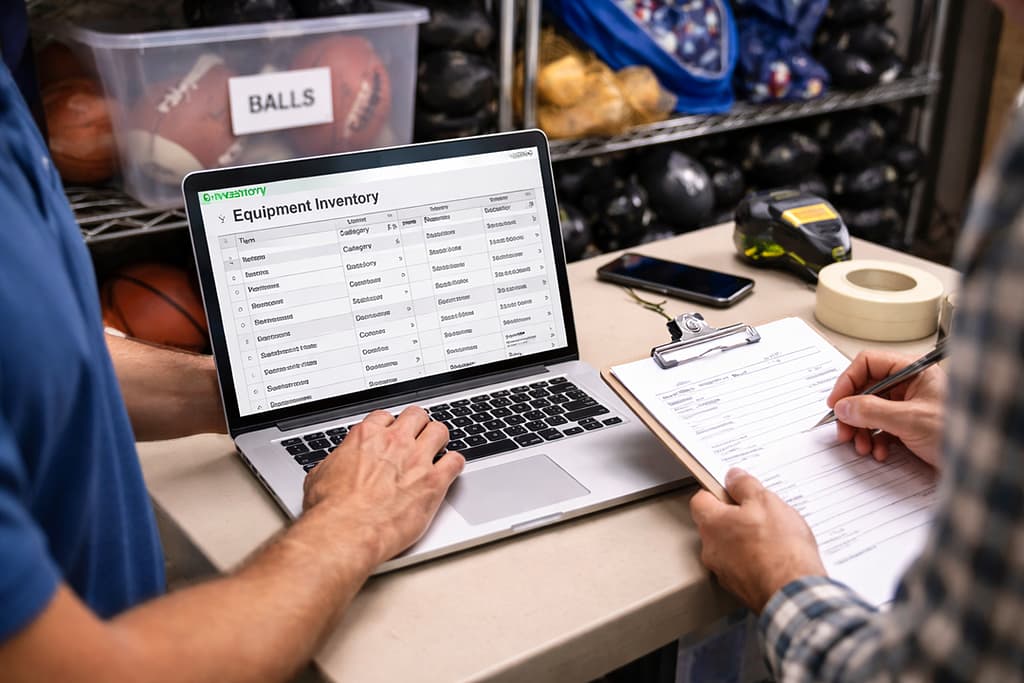
At minimum, every organization should maintain a centralized inventory log that records acquisition date, purchase cost, assigned team, storage location, and condition status.
Inventory Tracking Framework
| Asset Category | Tracking Method | Key Data Fields | Review Frequency |
|---|---|---|---|
| Uniforms | Serialized assignment | Player ID, return date, condition | End of season |
| Practice Equipment | Quantity log | Quantity on hand, condition | Monthly |
| Safety Equipment | Inspection checklist | Inspection date, compliance status | Pre-season + mid-season |
| Capital Equipment | Asset register | Purchase date, cost, lifespan | Annual |
The goal is not perfection. The goal is visibility.
Visibility reduces duplication purchases. It prevents shrinkage. It supports accurate insurance declarations. It ensures safety equipment is compliant and inspected.
Digital tools improve accessibility, but discipline matters more than software. A well-maintained spreadsheet outperforms an unused inventory app.
Consistency builds control.
Depreciation Awareness: Understanding Equipment Lifespan
Community programs often budget for equipment only when it breaks. This creates financial spikes that strain seasonal cash flow.
Depreciation is not only an accounting concept. It is a planning tool.
Every asset has a useful lifespan. Soccer balls degrade. Protective padding compresses. Portable goals rust. Storage sheds weather.
Replacement Planning Estimates
| Asset Type | Estimated Lifespan | Replacement Cycle | Budgeting Strategy |
|---|---|---|---|
| Game Balls | 1–2 seasons | Annual review | Allocate seasonal reserve |
| Uniform Sets | 2–3 seasons | Planned rotation | Multi-year budget forecast |
| Portable Goals | 5–7 years | Capital replacement | Long-term reserve fund |
| Storage Equipment | 7–10 years | Facility planning | Capital improvement plan |
| Safety Padding | 3–5 years | Safety audit review | Compliance reserve |
By projecting useful life, boards can allocate small annual reserves instead of facing sudden large expenses.
Depreciation awareness supports financial smoothing. Instead of scrambling for emergency funds, programs build replacement reserves gradually.
Predictability reduces stress.
Replacement Planning: From Reaction To Forecasting
Replacement planning transforms capital spending into a scheduled event rather than a crisis.
The strongest programs maintain a rolling three- to five-year capital forecast. This document outlines anticipated replacement cycles based on historical purchase dates and asset condition.
Capital Replacement Planning Model
| Year | Projected Replacement | Estimated Cost | Funding Source |
|---|---|---|---|
| 2026 | Uniform Rotation | $3,500 | Annual budget allocation |
| 2027 | Portable Goal Upgrade | $6,000 | Capital reserve fund |
| 2028 | Equipment Shed Replacement | $4,500 | Facility improvement fund |
| 2029 | Safety Padding Upgrade | $2,800 | Compliance reserve |
Forecasting allows leadership to align fundraising goals with capital needs. It prevents sudden dues increases. It demonstrates proactive financial management to members and families.
Strategic replacement planning also supports grant applications. Many funders require evidence of long-term asset management.
Planning signals credibility.
Asset Accountability And Assignment Protocols
Inventory systems fail when accountability is unclear.
Uniform distribution without documented return processes leads to loss. Shared equipment without assigned oversight leads to neglect.
Asset accountability should include:
- Signed assignment forms for serialized equipment
- End-of-season return verification
- Damage documentation process
- Storage location tracking
Assignment Responsibility Matrix
| Asset Type | Assigned To | Verification Process |
|---|---|---|
| Player Uniforms | Individual Player | Signed issuance + return check |
| Team Equipment Bags | Head Coach | Monthly inventory review |
| Safety Kits | Field Supervisor | Pre-event inspection |
| Capital Equipment | Program Director | Annual audit |
Accountability does not imply distrust. It reinforces stewardship, clearly defined board roles and oversight structures.
When responsibility is clear, care improves.
Insurance Alignment And Asset Documentation
Asset control directly impacts insurance coverage.
Underreporting equipment value creates underinsurance risk. Overreporting inflates premiums unnecessarily. Accurate inventory supports accurate declarations.
Insurance policies often require documented proof of ownership in the event of theft or damage claims.
An organized equipment storage facility with labeled shelves, serialized uniform bins, and a visible asset log clipboard mounted on the wall. In the foreground, a digital tablet displays an inventory tracking spreadsheet. Natural light highlights an orderly and professionally maintained storage environment.
Documentation protects reimbursement eligibility.
Inventory logs, purchase receipts, and condition reports should be securely archived. Cloud-based storage reduces loss risk compared to physical binders alone.
Risk management and asset control operate together.
Preventing Shrinkage And Loss
Equipment shrinkage in community programs typically occurs gradually.
Common causes include:
- Informal borrowing
- Poor return tracking
- Inadequate storage
- Lack of condition checks
Preventive controls reduce these exposures.
Loss Prevention Controls:
| Control Measure | Impact |
|---|---|
| Serialized labeling | Discourages untracked distribution |
| Controlled storage access | Limits unauthorized removal |
| Post-season reconciliation | Identifies missing assets |
| Coach accountability sign-off | Reinforces shared responsibility |
Loss prevention is not about suspicion. It is about operational discipline.
When inventory reconciliation becomes routine, financial accuracy improves.
Technology Integration In Asset Management
Technology can streamline asset oversight when used intentionally.
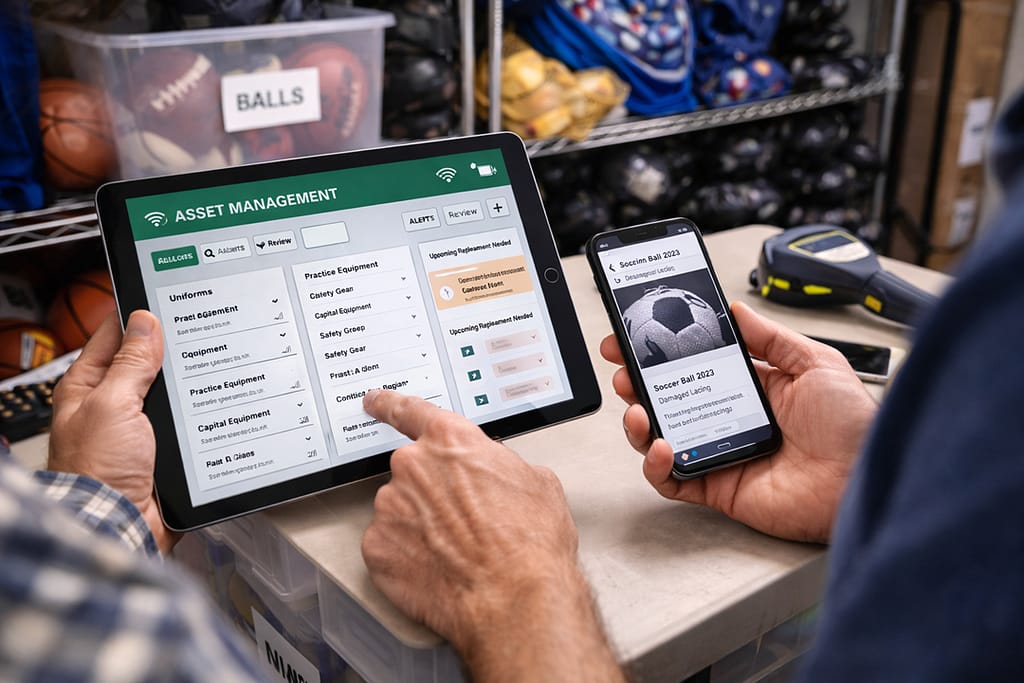
Digital inventory platforms allow:
- Real-time tracking
- Automated alerts for replacement cycles
- Condition documentation via photo upload
- Multi-user access with audit logs
However, technology should support process — not replace it.
Organizations must define review intervals, assign oversight responsibility, and conduct periodic audits regardless of platform choice.
Software enhances transparency. Governance ensures compliance.
Annual Asset Audit And Governance Review
An annual asset audit formalizes accountability.
The audit should confirm:
- Inventory accuracy
- Condition assessments
- Depreciation alignment
- Insurance coverage updates
- Replacement projections
Asset Governance Checklist
| Review Area | Key Question |
|---|---|
| Inventory Accuracy | Does physical count match asset log? |
| Replacement Forecast | Are projected timelines realistic? |
| Insurance Coverage | Does declared value reflect actual assets? |
| Condition Reporting | Are safety items compliant? |
| Documentation Archive | Are purchase receipts retained? |
Audits protect both budget integrity and operational readiness.
An organization that tracks its assets demonstrates stewardship. Stewardship builds trust.
Building A Culture Of Equipment Responsibility
Equipment control ultimately reflects culture.
When coaches model care, players return gear responsibly. When boards review asset reports regularly, financial discipline strengthens.
Community programs that treat equipment as long-term assets operate with greater stability. Replacement planning becomes predictable. Budgets become smoother. Risk exposure decreases.
Asset control is not administrative overhead.
It is infrastructure governance.
When inventory tracking is structured, depreciation is anticipated, and replacement planning is scheduled, community programs move from reactive spending to strategic investment.
That shift protects both financial health and program quality.