

Adult recreational leagues thrive on a simple promise: competitive games that remain welcoming, social, and fun. Yet achieving that balance is more complex than it appears. When competition becomes too uneven, new players lose interest. When leagues attempt to enforce strict parity, experienced players feel constrained.
The challenge for organizers is designing a structure that preserves fairness without eliminating the natural excitement of competition. League formats, team formation systems, and scheduling models all play a role in maintaining competitive balance.
Well-designed adult leagues recognize that fairness is not about making every game identical. It is about creating systems where teams feel they have a legitimate chance to compete each week.
Why Competitive Balance Matters In Recreational Leagues
Unlike professional or elite amateur leagues, adult recreational leagues typically serve participants with widely varying skill levels. Some players may have years of competitive experience, while others join primarily for exercise or social connection.
Without intentional league design, these differences can quickly create mismatches. Games become lopsided, stronger teams dominate standings, and less experienced players feel discouraged.
Competitive balance improves the overall experience for all participants. When teams feel evenly matched, games remain engaging and unpredictable. Players stay motivated throughout the season, and leagues experience higher retention rates year after year.
Recreational leagues that prioritize fairness often find that participation grows naturally because players feel both challenged and welcomed.
Understanding Skill-Level Divisions
One of the most effective tools for maintaining competitive balance is dividing leagues by skill level. Not every adult participant seeks the same level of intensity, and separating divisions helps leagues accommodate diverse player expectations.
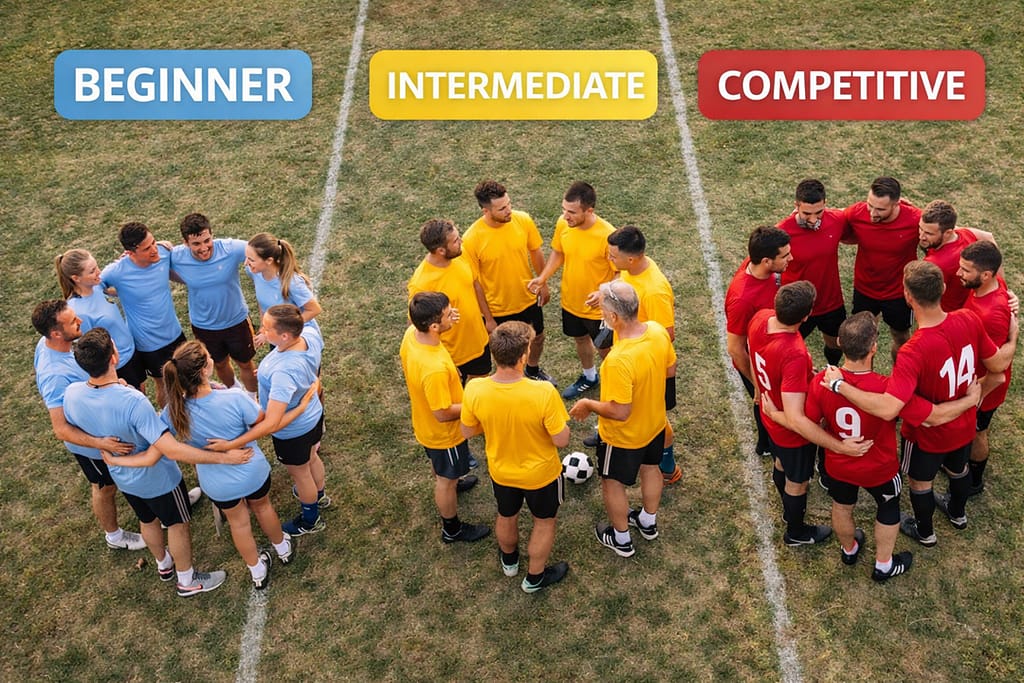
Skill-tiered divisions allow beginners to develop confidence while experienced players continue to enjoy challenging competition.
Adult League Skill Division Example
| Division Level | Typical Player Profile | Competitive Focus |
|---|---|---|
| Beginner | New or returning players | Learning rules and basic skills |
| Intermediate | Recreational players with experience | Balanced competition |
| Competitive | Former competitive or high-skill athletes | Faster pace and strategic play |
Divisions also simplify scheduling and playoff structures because teams within each tier tend to produce more competitive games.
Leagues that adopt skill-based tiers often see fewer blowout games and greater participant satisfaction across all divisions.
Draft Systems Versus Preformed Teams
Another structural decision leagues must address is how teams are formed. Many adult leagues allow players to register as preformed teams, while others rely on draft or assignment systems to balance rosters.
Each approach offers distinct advantages.
Team Formation Models
| Model | Description | Competitive Impact |
|---|---|---|
| Preformed Teams | Players register with friends or coworkers | Strong chemistry but possible imbalance |
| Draft System | Players assigned to teams through organized selection | Higher competitive balance |
| Free Agent Pool | Individual players distributed across teams | Helps fill roster gaps |
Preformed teams often create strong social bonds, which is a major reason adults join recreational leagues. However, leagues that rely exclusively on preformed teams sometimes experience large skill disparities between teams.
Hybrid models can help address this challenge. For example, leagues may allow partial team registration while distributing free agents across rosters to maintain balance.
This approach preserves social elements while preventing extreme competitive gaps.
Scheduling Systems That Promote Fair Play
League scheduling can also influence competitive balance. A poorly designed schedule may unintentionally favor certain teams, particularly if stronger teams face weaker opponents early in the season.
Balanced scheduling models ensure that teams face a variety of opponents and reduce the likelihood of repetitive mismatches.
Common Scheduling Structures
| Format | Description | Best Use Case |
|---|---|---|
| Round Robin | Every team plays each opponent once | Smaller leagues |
| Double Round Robin | Teams face each other twice | Medium-sized leagues |
| Tiered Scheduling | Teams regroup based on standings midseason | Large leagues |
Tiered scheduling systems are increasingly popular because they allow leagues to adjust competition levels during the season. Teams with similar records compete against one another in later rounds, creating more competitive matchups.
Leagues that regularly evaluate their schedules can maintain fairness while still keeping the season exciting.
Preventing Dominant “Super Teams”
One of the biggest challenges in adult leagues is the formation of dominant teams composed entirely of highly skilled players. While such teams may form naturally among experienced groups, their presence can discourage participation if the competitive gap becomes too large.
League administrators often address this issue through roster guidelines. These guidelines may include skill caps, player rotation rules, or limits on the number of advanced players per team.
The goal is not to restrict competition but to ensure that games remain engaging for all participants.
Many leagues also monitor team performance throughout the season. When a team consistently wins by large margins, organizers may adjust future scheduling or encourage division reassignment in subsequent seasons.
These adjustments protect league integrity while maintaining a welcoming environment.
Using Data And Feedback To Improve Competitive Structures
Competitive balance should never be treated as a static design. The most successful adult leagues regularly evaluate league outcomes and participant feedback.

Tracking basic league data can reveal valuable insights.
| Metric | What It Reveals |
|---|---|
| Average goal or point differential | Indicates game competitiveness |
| Player retention rates | Measures overall satisfaction |
| Division participation levels | Identifies demand across skill tiers |
| Game attendance trends | Reflects engagement and excitement |
Collecting this information allows organizers to refine league structures each season.
Many leagues also follow best practices promoted by organizations like the Sports & Fitness Industry Association, which studies adult recreational participation trends and highlights strategies for sustainable community sports programs.
Data-driven adjustments ensure leagues evolve alongside their players.
Building Recreational Leagues That Prioritize Fair Play
The ultimate goal of adult recreational sports is simple: enjoyable competition that encourages continued participation. Fair league structures support that goal by ensuring players feel both challenged and included.
Thoughtful division structures, balanced team formation models, and flexible scheduling systems all contribute to a league environment where every game matters.
League organizers who prioritize fairness also strengthen community trust. Players return season after season because they know the league values both competition and accessibility.
For organizers planning broader league operations, frameworks such as registration capacity planning strategies can also support competitive balance by ensuring teams remain appropriately sized and evenly distributed across divisions.
In the end, fair competitive structures do more than improve standings.
They create leagues where players keep showing up—season after season—because the games remain competitive, social, and worth playing.